


Patchy beard growth is a common concern for men who want a fuller, more balanced beard but notice that some parts of their face grow faster or denser than others. The cheeks may look sparse, the mustache may not fully connect to the beard, or certain areas along the jawline may remain visibly thinner. Although patchy beard growth can be disappointing, it does not always mean that growing an attractive beard is impossible.
Facial hair develops according to a combination of genetics, age, natural follicle distribution, hormones, skin condition, grooming habits, and overall health. In many cases, the goal should not be to force every part of the beard to grow at exactly the same density. Instead, understanding your natural beard pattern and learning how to make the most of existing growth can produce a much thicker and more polished appearance.
Patchy Beard Growth: Why Does a Beard Grow in Patches?
Every beard develops from thousands of individual hair follicles. These follicles are not distributed evenly across the face, which is one of the main reasons some areas naturally look denser than others.
For many men, the chin and mustache develop first, while the cheeks take longer to fill in. Others may have strong sideburn growth but weaker areas around the mouth. These differences can be noticeable even between the left and right sides of the same face.
Genetics plays the biggest role in determining where facial hair grows and how dense it becomes. If your natural follicle distribution includes fewer active follicles on the cheeks, for example, those areas may continue to look lighter even when the rest of the beard becomes dense.
Age is another important factor. Beard development can continue well into adulthood. Someone in their late teens or early twenties may have visibly patchy beard growth that becomes more complete several years later. This is why it is often too early to make permanent conclusions about beard density at a young age.
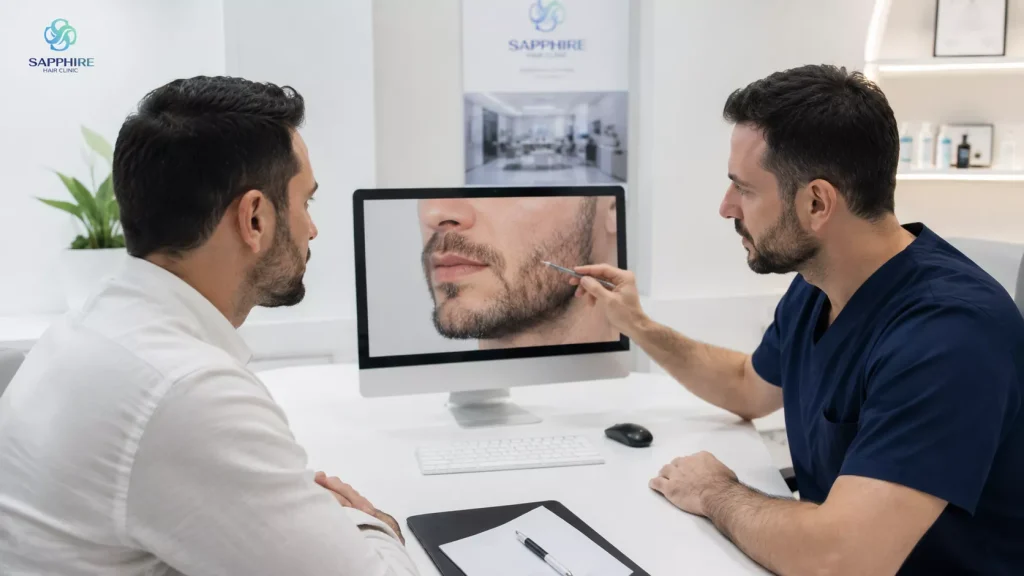
Patchy Beard Growth: What Are the Main Reasons for a Thin-Looking Beard?
Several biological and lifestyle factors can influence how thick or uneven facial hair appears.
- Genetic characteristics: Your genes influence follicle density, hair texture, beard pattern, and how strongly individual follicles respond to hormones.
- Age: Beard density may continue developing throughout the twenties and sometimes beyond.
- Uneven follicle distribution: Certain areas of the face may naturally contain fewer active beard follicles.
- Hair length: Very short facial hair tends to make differences in density much more visible.
- Skin condition: Irritated, extremely dry, or unhealthy skin can make beard growth look rough and poorly maintained.
- Nutrition: Significant nutritional deficiencies can potentially affect normal hair health.
- Stress and sleep: Long-term stress and poor sleep may affect general health and indirectly influence hair condition.
- Certain hair or skin conditions: Sudden beard loss or clearly defined bald patches may require evaluation by a dermatologist.
The important point is that patchy beard growth does not have one universal cause. For one person it may simply be genetic, while another may be dealing with temporary changes in hair condition.
Patchy Beard Growth: Can Your Beard Become Thicker With Age?
Yes, beard density can change as a man gets older. Facial hair does not necessarily reach its final pattern immediately after puberty.
Many men notice that areas that were previously thin begin producing stronger or darker hairs during their twenties. The connections between the mustache and beard may improve, the jawline may appear denser, and cheek growth can gradually become more noticeable.
However, there is no exact age at which everyone develops a complete beard. Some men grow dense facial hair very early, while others experience slower development. Genetics remains the strongest influence.
If you are relatively young and your patchy beard growth has been gradually improving, giving it time may be more useful than constantly searching for fast beard-growth solutions.
Patchy Beard Growth: How Long Should You Grow a Beard Before Judging It?
One of the biggest mistakes men make is deciding that their beard is too patchy after only one or two weeks.
Short beard hair exposes every small difference between follicles. Some hairs grow faster, others remain shorter, and areas with slightly lower density appear more obvious.
Allowing your facial hair to grow for several weeks gives longer hairs an opportunity to overlap and naturally cover smaller gaps. For many men, approximately four to eight weeks provides a much better picture of how the beard actually looks when developed.
During this period, it can be helpful to avoid unnecessary trimming across the main beard area. You may still keep the neckline clean and remove obvious stray hairs, but repeatedly shortening the cheeks and jaw can prevent the beard from reaching the length needed to look fuller.
Once the beard has grown sufficiently, it becomes easier to determine which patches can be disguised through styling and which areas are naturally more sparse.
Patchy Beard Growth: Does Shaving Help Facial Hair Grow Back Thicker?
Shaving does not increase the number of hair follicles in your face and does not permanently make beard hair thicker.
When hair is shaved, the razor cuts it across the shaft. As the hair begins growing again, the cut end feels rougher and may look darker because it has not yet developed the naturally tapered tip of longer hair.
This can create the temporary illusion that the beard has become stronger after shaving. Biologically, however, the follicle remains the same.
Repeatedly shaving patchy areas will therefore not force new follicles to appear. If you prefer a clean-shaven look while waiting for your facial hair to mature, shaving is perfectly reasonable. It simply should not be considered a beard-thickening treatment.
Patchy Beard Growth: How Can You Support Healthier Facial Hair?
Healthy daily habits cannot completely override genetics, but they can support the normal condition of your skin and existing facial hair.
- Eat enough protein and maintain a varied diet containing vegetables, fruits, healthy fats, and nutrient-rich foods.
- Maintain a regular sleep schedule instead of consistently sleeping too little.
- Exercise regularly as part of an overall healthy lifestyle.
- Wash your face and beard gently without using unnecessarily harsh cleansers.
- Moisturize the skin under your beard if it becomes dry, tight, or flaky.
- Comb or brush longer beard hair carefully rather than aggressively pulling it.
- Avoid constantly scratching, twisting, or pulling beard hairs.
- Give facial hair enough time to develop before changing your routine repeatedly.
These habits are most useful when viewed as part of general beard maintenance rather than instant growth techniques. Healthy facial hair often looks thicker because it is softer, less brittle, easier to style, and more consistent in appearance.
Patchy Beard Growth: Can Nutrition Make Your Beard Look Fuller?
A balanced diet supports normal hair growth because the body requires sufficient energy, protein, vitamins, minerals, and healthy fats to maintain hair-producing tissues.
Protein is particularly relevant because hair is largely composed of keratin. Foods containing iron, zinc, vitamin D, B vitamins, and other micronutrients can also contribute to general hair health when included as part of a varied diet.
However, beard supplements should not automatically be considered necessary. If you already receive sufficient nutrients through your normal diet, taking additional amounts is unlikely to transform genetically sparse areas into a dense beard.
Excessive supplementation can also be unnecessary and, in certain situations, harmful. If you suspect a nutritional deficiency because of other symptoms or significant dietary restrictions, professional evaluation is more appropriate than relying on random supplements promoted online.
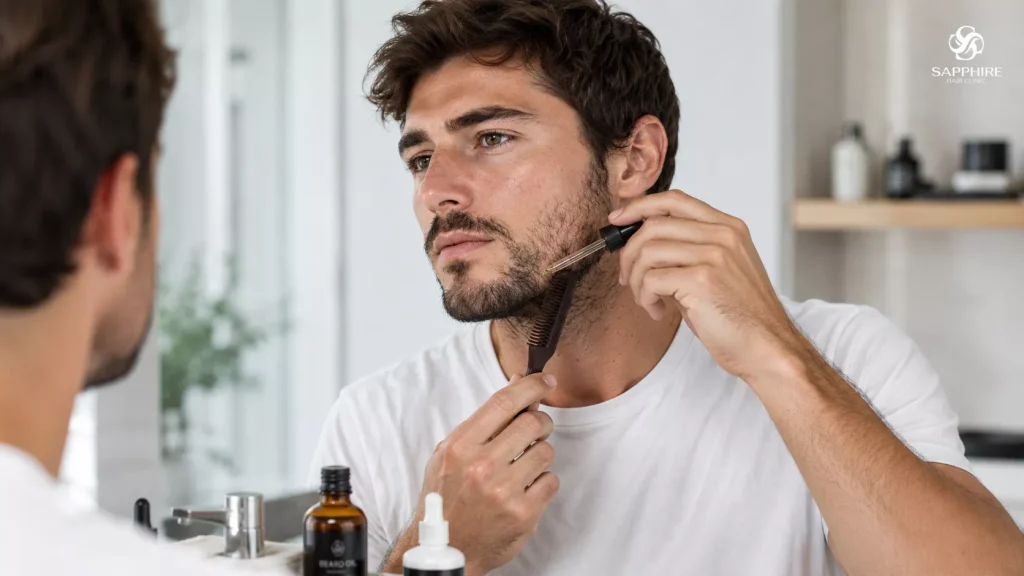
Patchy Beard Growth: Can Beard Oil Make Facial Hair Thicker?
Beard oil can make facial hair look healthier, but it should not be confused with a product that creates completely new beard follicles.
Its primary purpose is conditioning. Beard oils can soften coarse hair, reduce dryness, improve manageability, and moisturize the skin beneath the beard. This can make the beard look smoother and more controlled.
A better-conditioned beard may also appear slightly fuller because dry and brittle hairs often sit awkwardly and make thinner areas more noticeable. Once the hairs become easier to brush and style, they can provide better visual coverage.
Still, cosmetic beard oils cannot change your genetic follicle distribution. They are most valuable as grooming products rather than miracle growth treatments.
Patchy Beard Growth: How Can Styling Make a Beard Look Thicker?
Good styling can significantly improve the appearance of a patchy beard without changing actual hair density.
The first step is identifying where your facial hair grows strongest. If your chin and mustache are dense but your cheeks are weaker, a style that emphasizes the center of the face may look more balanced than attempting to maintain a large full beard.
If your jawline grows well, keeping the upper cheek line slightly lower and more defined can reduce the contrast between thick and thin sections.
Beard length also matters. Moderate length often helps cover small gaps, while excessively long facial hair may sometimes exaggerate differences if certain sections remain very thin.
Using a comb or beard brush to guide hairs in a consistent direction can create a more uniform surface. The goal should be natural coverage rather than aggressively forcing long hairs across large bald areas.
Patchy Beard Growth: Which Beard Styles Work Best for Sparse Areas?
The best beard style depends on your individual growth pattern rather than a universal rule.
Men with strong chin growth and weaker cheeks often suit a goatee, extended goatee, or circle beard. These styles use naturally dense areas without drawing unnecessary attention to sparse cheek growth.
A short boxed beard can work well when the lower jaw grows densely but upper cheek areas remain thin. Carefully defining the cheek line creates a deliberate shape that makes the difference in density less noticeable.
Short stubble is another excellent option. When the entire beard is maintained at a similar short length, variations between dense and sparse areas may become visually softer.
For men with relatively minor patchy beard growth, a medium-length beard can provide enough coverage for surrounding hairs to conceal smaller spaces naturally.
Patchy Beard Growth: How Should You Trim a Patchy Beard?
Trimming should create balance rather than simply making every section the same length.
If one area grows much faster than another, lightly reducing the fastest-growing sections can help the entire beard appear more even. At the same time, sparse areas may benefit from being left slightly longer so they gain additional visual coverage.
The neckline is especially important. A poorly defined neckline can make even a naturally dense beard look untidy. A clean lower edge creates structure and directs attention toward the overall beard shape instead of individual patches.
The cheek line should also follow your natural growth. Trying to preserve several isolated hairs far above the main beard can actually make patchiness more noticeable. A cleaner, intentional cheek boundary usually creates a stronger appearance.
Patchy Beard Growth: Can Stress Affect Beard Health?
Periods of significant or prolonged stress can affect the body in many ways. Hair growth cycles may sometimes respond to severe physical or emotional stress, illness, poor sleep, major dietary changes, or other disruptions.
Stress can also indirectly affect beard condition. Someone experiencing chronic stress may sleep poorly, eat less consistently, neglect skin care, or develop habits such as repeatedly touching or pulling facial hair.
Reducing stress should therefore be seen as part of general health maintenance. Regular physical activity, sufficient sleep, adequate rest, and a balanced daily routine can support overall wellbeing and may help maintain healthier-looking facial hair.

Patchy Beard Growth: When Should You Consider Seeing a Dermatologist?
A beard that has always grown unevenly is usually very different from a beard that suddenly develops bald areas.
If facial hair disappears from a region that previously grew normally, especially when the patch appears round, sharply defined, inflamed, or irritated, it may be worth speaking with a dermatologist.
Persistent redness, scaling, itching, pain, scarring, or sudden hair loss in other parts of the body can also justify professional assessment.
Online photographs and general beard advice cannot reliably diagnose hair-loss conditions. Different dermatological problems can produce similar visible symptoms, which is why professional evaluation may be important when the beard changes unexpectedly.
Patchy Beard Growth: How Long Does It Take to Achieve a Fuller Look?
There is no single timeline that works for everyone.
Men with relatively small gaps may notice that several additional weeks of growth significantly improves the appearance of their beard. Longer surrounding hairs can cover thin areas and create a more continuous shape.
Someone with larger areas containing very few active follicles may see less change from additional length alone. In this situation, selecting a different beard style can often provide a better visual result than simply continuing to grow everything longer.
Taking photographs every few weeks under similar lighting can help you judge progress more accurately. Daily mirror checks can make it difficult to recognize gradual improvements.
Patchy Beard Growth: Frequently Asked Questions
Patchy Beard Growth: Can Patchy Areas Fill In Naturally?
Yes, some patchy areas can become less noticeable naturally. Younger men may experience continued facial hair development as they age, while existing surrounding hairs may also become long enough to cover smaller gaps.
However, completely bare areas caused by naturally low follicle density may remain sparse. Genetics determines much of your facial hair pattern, so realistic expectations are important. Even when actual density does not change significantly, the correct beard length and style can make the overall beard look considerably fuller.
Patchy Beard Growth: Why Is One Side of My Beard Thicker?
Facial hair is not perfectly symmetrical. One side may contain more active follicles, or individual hairs may grow at slightly different speeds and angles.
Small differences between sides are extremely common. Allowing both sides to gain sufficient length before trimming makes it easier to create a balanced appearance. The denser side can then be trimmed slightly more while the thinner side retains enough length for coverage.
Patchy Beard Growth: Is a Thin Beard Always Genetic?
Not always, although genetics is one of the most important factors. Age, nutrition, skin health, certain medical conditions, and changes in overall health can also affect facial hair appearance.
A beard that has always been thin or uneven is more likely to reflect natural follicle distribution. Sudden changes, particularly when accompanied by irritation or clearly defined bald areas, deserve closer attention.
Patchy Beard Growth: What Is the Best Way to Make a Beard Look Thicker?
The most effective approach combines patience with smart grooming. Allow enough time for your facial hair to grow, keep the skin underneath healthy, maintain a clean neckline, select a beard shape that emphasizes your strongest areas, and avoid constantly shaving or restarting the growth process.
A fuller-looking beard is not always the result of growing more hair. In many cases, better length management, cleaner lines, proper conditioning, and choosing the right style create the biggest visual improvement.