



Clascoterone is gaining attention because it offers a different way to target androgen activity in male pattern hair loss. Positive late-stage findings have strengthened interest in its investigational scalp formulation.
Yet the attention surrounding a medicine can move faster than the evidence supporting everyday use. Clascoterone for hair loss deserves consideration as an emerging treatment, with clear distinctions between potential, measured results, and regulatory approval. Understanding those distinctions makes the research more useful than any promise of a breakthrough.
Why Is There Interest in Another Hair Loss Treatment?
Existing treatments help many people, but they do not suit every situation. Some patients find daily application difficult, while others have concerns about adverse effects or disappointing results.
That leaves room for additional options with different mechanisms and practical characteristics. It needs a well-defined role supported by evidence. Clascoterone attracts interest because it could eventually broaden that choice, although its place in routine care remains unsettled.
What Makes Clascoterone’s Mechanism Different?
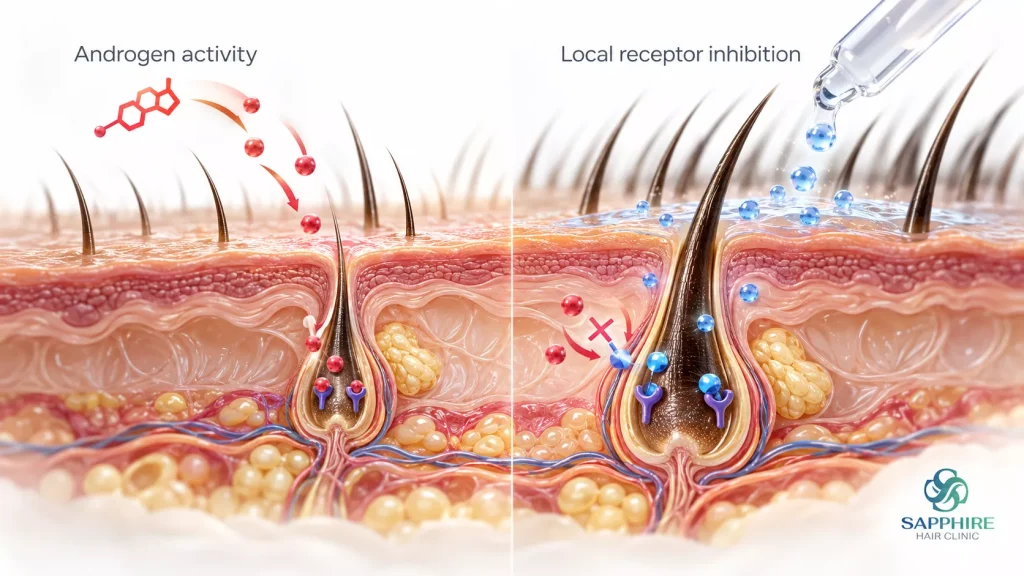
Clascoterone is an androgen receptor inhibitor designed for topical use. In male pattern hair loss, genetically susceptible follicles respond to androgen signalling, particularly involving dihydrotestosterone, or DHT. Over time, affected follicles produce smaller, finer hairs. This gradual miniaturisation explains why density can decline before obvious bald areas develop.
The investigational scalp solution aims to interfere with androgen activity at the receptor. That differs from reducing DHT production, as finasteride does. The distinction is biologically interesting, but it cannot establish better results by itself. A treatment’s value depends on what patients experience, how consistently benefits occur, and whether continued use is tolerable.
Is the Hair Loss Treatment the Same as Winlevi?
The hair loss formulation is different from Winlevi, the clascoterone cream approved in the United States for acne. Development for male androgenetic alopecia has focused on a 5% scalp solution, commonly associated with the name Breezula. The active ingredient is shared, but concentration and formulation differ.
| Feature | Winlevi | Investigational hair loss solution |
|---|---|---|
| Active ingredient | Clascoterone | Clascoterone |
| Concentration | 1% | 5% in the pivotal programme |
| Formulation | Cream | Topical scalp solution |
| Intended use | Acne treatment | Male pattern hair loss |
| Approval implication | Approval applies to acne | Separate assessment is required |
This matters when an online discussion treats the products as interchangeable. Applying an acne cream to thinning areas does not reproduce the tested scalp formulation. Existing experience with an ingredient can inform development, but it does not establish the right dose or expected benefit for another condition.

Which Clinical Findings Have Increased Interest?
SCALP 1 and SCALP 2 enrolled 1,465 men in the United States and Europe. Initial findings released in December 2025 showed statistically significant improvements in target-area hair count compared with vehicle. Vehicle is the preparation without the active ingredient. These results moved the discussion beyond a theoretical mechanism.
Twelve-month findings available in April 2026 suggested continued improvement with ongoing treatment. Participants switched to vehicle after six months lost some gains. However, the extension included initial responders. Its results therefore describe a selected group and should not be presented as the expected outcome for everyone starting treatment.
Why Do Hair-Count Headlines Need Context?
A large relative percentage can sound like a dramatic increase in total hair coverage. In reality, it may describe the difference between changes in two study groups. The absolute counts and starting values are needed to understand that comparison. A percentage alone cannot predict how much fuller someone’s hair will look.
| Evidence detail | Why it matters to patients |
|---|---|
| Absolute hair-count change | Shows the measured difference behind a percentage |
| Standardised photographs | Helps connect measurements with visible appearance |
| Participant characteristics | Shows how closely the study resembles your situation |
| Treatment duration | Establishes when the outcome was measured |
| Patient-reported improvement | Adds the user’s perspective to objective results |
Statistical significance also differs from personal satisfaction. A measurable gain may matter greatly to one patient and feel insufficient to another. Research should help set those expectations rather than encourage the same promise for everyone.
What Could Make Clascoterone Useful in Practice?
- A different biological target could expand the range of treatments discussed with suitable patients.
- A topical formulation may appeal to people who prefer scalp application, provided its safety and effectiveness meet their needs.
- Evidence of benefit during continued use makes maintenance an important subject for further evaluation.
- Future comparative studies could clarify whether it offers advantages for particular patient groups.
- Research into combinations could explore additional benefits, although compatible mechanisms do not establish a proven combination regimen.
Does Topical Application Mean Fewer Side Effects?
Topical application is intended to act at the treatment site, but it does not automatically eliminate systemic exposure or adverse effects. Initial pivotal findings indicated similar adverse-event patterns between the active treatment and vehicle groups. This is encouraging evidence within those trial conditions, rather than a guarantee for every future user.
The approved acne cream includes warnings about irritation and adrenal-axis suppression; elevated potassium was also observed during acne studies. Those findings cannot be treated as the side-effect profile of the 5% scalp solution. They explain why formulation-specific evidence matters. Safety assessment must consider concentration, application conditions, duration, and the population receiving treatment.
Who Might Find the Research Most Relevant?
The pivotal programme is most directly relevant to adult men with androgenetic alopecia. The twelve-month follow-up concerned men with mild-to-moderate loss. Findings from these participants should not automatically be extended to women, children, or people with unrelated causes of shedding. Future prescribing criteria would depend on regulatory review.
Diagnosis remains the starting point. Sudden shedding after illness, autoimmune hair loss, nutritional problems, and inflammatory scalp conditions can require different approaches. A receding hairline and patchy loss are not interchangeable diagnoses. Before considering an emerging medicine, an assessment should establish what is happening and whether androgen-directed treatment is relevant.
How Does It Compare With Current Options?
Clascoterone cannot yet be described as a proven replacement for finasteride, minoxidil, or surgery. Each approach addresses hair loss differently, and the appropriate choice depends on the patient. Trials against vehicle do not provide a direct ranking against established medicines.
| Option | Main purpose or mechanism | Practical distinction |
|---|---|---|
| Clascoterone scalp solution | Local androgen receptor inhibition | Investigational for hair loss |
| Oral finasteride | Reduced DHT production | Prescription medical treatment |
| Topical minoxidil | Promotion of hair growth | Regular application to maintain benefit |
| Hair transplantation | Redistribution of donor follicles | Surgical planning and donor assessment |
For people exploring surgery, understanding the hair transplant procedure helps separate graft placement from medical maintenance. Medication works on existing follicles, while transplantation relocates follicles into selected areas. Those roles can be discussed together without assuming that a future drug will remove the need for surgery.
What Questions Should Patients Ask About New Treatments?
- Does the research involve people with my diagnosis, age range, and extent of thinning?
- Are the results based on complete clinical data or an initial summary?
- What improvement was visible, and how many participants experienced a meaningful benefit?
- What adverse effects occurred, and how long were participants followed?
- Is the proposed treatment authorised locally, and what evidence supports the exact formulation being offered?

How Could This Affect Plans for a Hair Transplant?
Interest in clascoterone should encourage a careful discussion about preserving existing hair alongside restoring coverage. It should not dictate a surgical decision before individual assessment. Donor capacity, scalp health, the pattern of loss, and realistic expectations remain central. A future medication cannot be assumed to solve limitations in donor supply.
Patients comparing Sapphire FUE hair transplantation with medical approaches should clarify the goal of each option. The useful question is how a plan addresses current concerns while allowing for future thinning. You can contact Sapphire Hair Clinic for an assessment and a discussion of available restoration options.
Frequently Asked Questions
Is Clascoterone Approved for Hair Loss Yet?
As of September 25, 2026, the studied scalp solution remains investigational. Planned US and European regulatory submissions are scheduled for the first and second quarters of 2027, respectively. These are application targets, not confirmed approval dates or guarantees of availability.
Could It Regrow Hair in Completely Bald Areas?
The available findings do not establish complete restoration of longstanding bald areas. They concern measured improvement in studied participants, rather than the creation of new follicles. Expectations should reflect the extent of hair loss and the limits of the evidence.
Would Treatment Need to Continue?
The withdrawal findings suggest that maintenance would matter. Participants who switched away from active treatment lost some gains. However, any future routine dosing schedule and long-term treatment recommendations would need to follow approved prescribing information.
Should I Wait for Clascoterone Before Seeking Advice?
There is no need to postpone an assessment while following the research. Understanding your diagnosis and current options can help you make better decisions now. An existing plan can be reviewed if a new treatment becomes available and proves appropriate for your circumstances.