


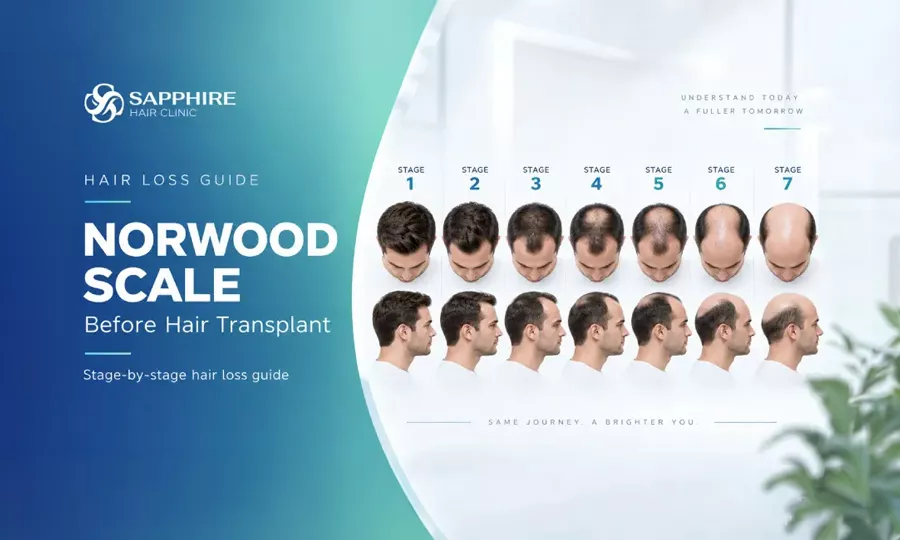
Hair transplant planning starts with understanding the pattern of hair loss. The Norwood Scale helps show how advanced that pattern is and gives the surgeon a practical starting point for estimating coverage.
The Norwood Scale Before Hair Transplant evaluation divides male pattern baldness into seven stages. It cannot give an exact graft number, because donor density, hair thickness, scalp size, age and the desired result still affect the final plan.
What Is the Norwood Scale?
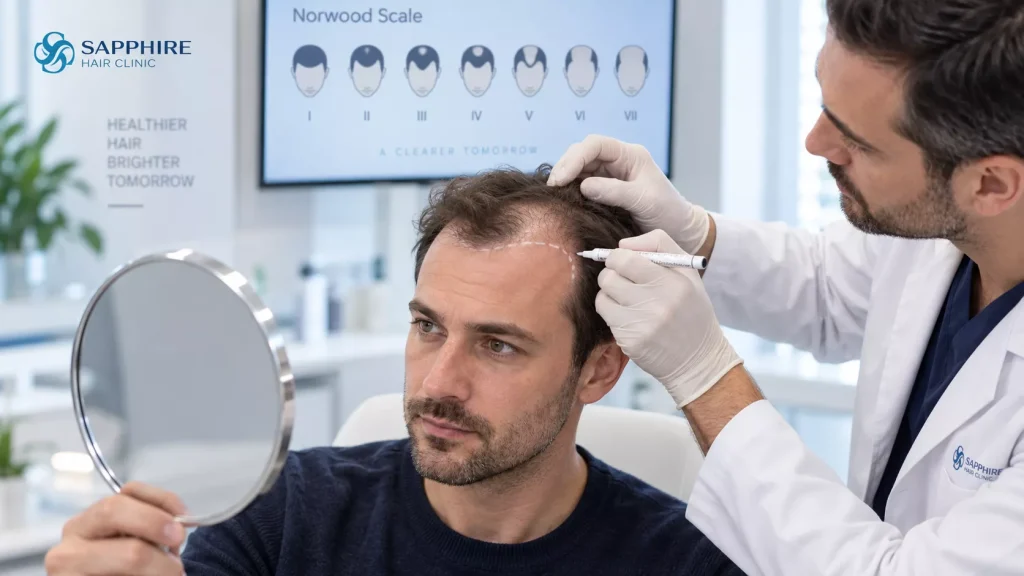
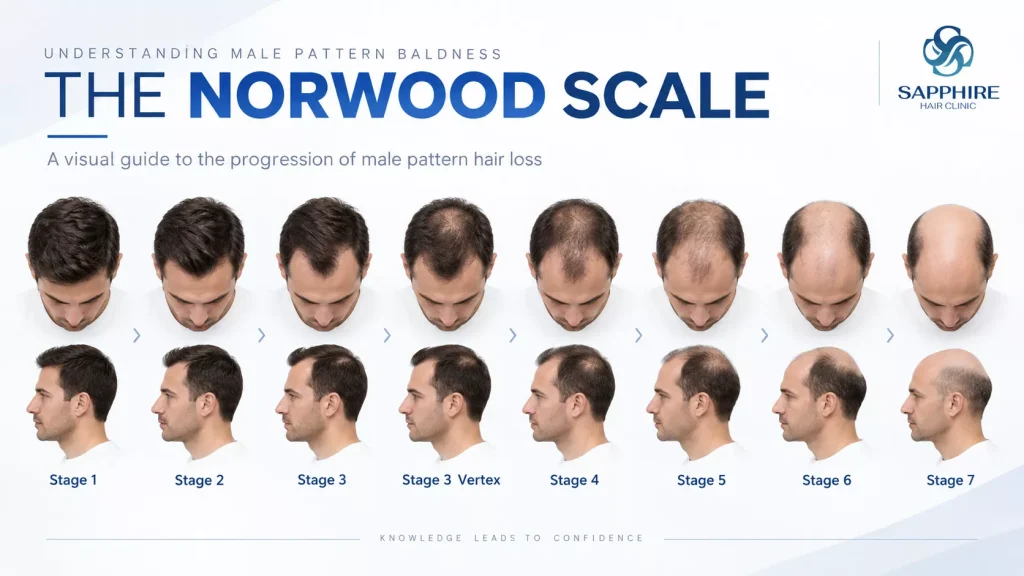
The Norwood Scale, also called the Hamilton-Norwood Scale, classifies common male hair loss patterns from Stage 1 to Stage 7. Stage 1 shows little visible recession, while Stage 7 represents extensive loss across the top of the scalp.
Two patients at the same stage can still need different graft numbers because donor quality, hair thickness and scalp size differ. The scale is therefore a guide, not a fixed graft calculator.
| Norwood Stage | Typical Pattern | Approximate Graft Range |
|---|---|---|
| Stage 1 | Little or no visible recession | Usually no transplant |
| Stage 2 | Mild temple recession | 800–1,500 |
| Stage 3 | Deeper temple and frontal recession | 1,500–2,800 |
| Stage 3 Vertex | Frontal recession plus early crown loss | 2,000–3,200 |
| Stage 4 | Frontal loss with separate crown thinning | 2,500–4,000 |
| Stage 5 | Larger frontal and crown areas | 3,500–4,500 |
| Stage 6 | Front and crown loss have merged | 4,000–5,500 |
| Stage 7 | Extensive loss across the top | Case by case, often staged |
Norwood Stage 1: Usually Too Early for Surgery
At Norwood 1, there is little evidence of true male pattern recession. Some men naturally have a slightly higher or mature hairline, which can look like early hair loss even when the pattern is stable. In most cases, surgery is not necessary at this point.
If thinning is suspected, monitoring the hairline over time may be more useful than immediately using donor grafts. The cause of the change should also be assessed before surgery is discussed.
Norwood Stage 2: Small Hairline Corrections
Norwood 2 usually involves mild recession at the temples while the central hairline remains relatively strong. When the pattern is stable, approximately 800 to 1,500 grafts may be enough for a focused correction.
The aim is not simply to fill the corners. The new hairline should remain believable as the patient ages, because an overly low design can use unnecessary grafts and become harder to maintain if native hair continues to thin.
Norwood Stage 3: A Common Point for Hair Transplant
At Norwood 3, temple recession becomes much more noticeable and the frontal hairline often forms a stronger M shape. This is a common stage for patients to consider surgery because the change is visible even when the hair is styled.
Around 1,500 to 2,800 grafts may be considered for the frontal area. The final number depends on forehead width, recession depth and the density planned behind the hairline.
Norwood Stage 3 Vertex: When the Crown Also Needs Attention
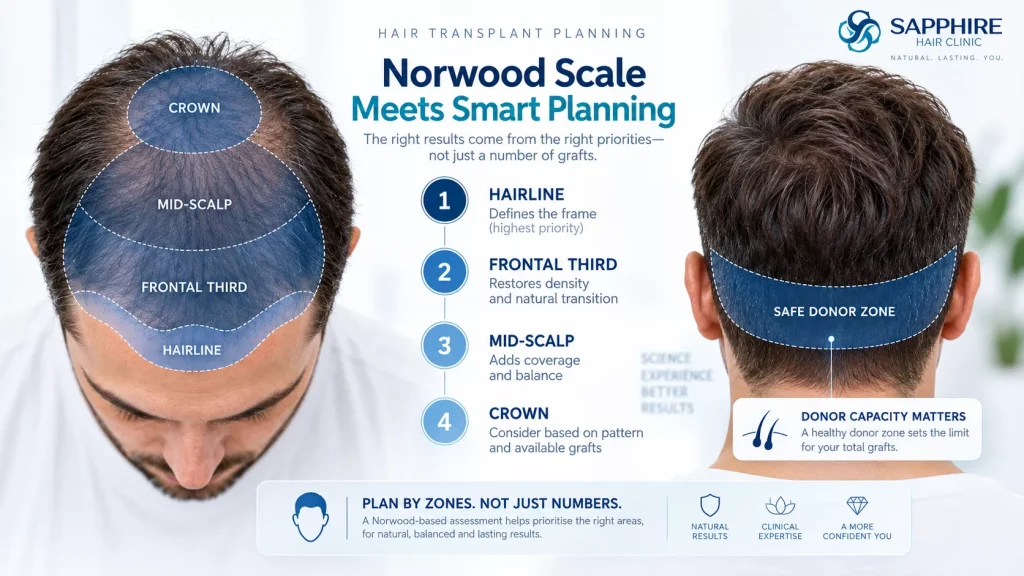
Norwood 3 Vertex includes thinning at the crown in addition to frontal recession. This changes the graft calculation because the crown can consume many follicular units, especially when the thinning area is wide.
Roughly 2,000 to 3,200 grafts may be discussed. If donor supply is limited, the frontal area often receives greater priority because it has a stronger effect on facial appearance.
| Area | Typical Priority | Planning Reason |
|---|---|---|
| Hairline | Very high | Frames the face |
| Frontal third | Very high | Gives the strongest impression of density |
| Mid-scalp | Medium to high | Connects front and crown |
| Crown | Variable | Can require many grafts |
Norwood Stage 4: Front and Crown Must Be Balanced
Norwood 4 usually shows deeper frontal recession together with clearer crown loss, but a band of existing hair still separates the two areas. More surface area now needs coverage, so graft placement has to be planned more carefully.
Many Stage 4 cases fall around 2,500 to 4,000 grafts. Some patients prefer stronger frontal density with lighter crown coverage, while others choose a more even distribution.
Norwood Stage 5: Donor Management Becomes Important
At Norwood 5, the frontal and crown areas are larger and the remaining bridge of hair between them becomes narrower. Around 3,500 to 4,500 grafts may be considered, although some patients are better treated in more than one session.
A surgeon may place the greatest density in the hairline and frontal third, then reduce it toward the crown to avoid exhausting the donor area in one operation.
Norwood Stage 6: Coverage Has to Be Realistic
By Norwood 6, frontal and crown loss have largely merged. The bald or very thin area covers most of the top of the scalp, while the donor area remains limited. A transplant can still be possible, but planning has to be realistic.
Approximately 4,000 to 5,500 grafts may be used across one or more sessions when donor quality is suitable. Full youthful density is rarely realistic; restoring the frontal frame and mid-scalp usually creates more visual value.
Norwood Stage 7: Every Case Needs Individual Planning
Norwood 7 is the most advanced stage. Hair mainly remains around the sides and back, while the top has extensive loss. The recipient area can be much larger than the scalp donor area can safely support.
Some patients may be candidates for staged restoration, while others may be advised to focus only on the front. The priority is safe extraction without leaving the donor area visibly depleted.
Why Do Graft Numbers Vary at the Same Norwood Stage?
The Norwood Scale describes the pattern of loss, not donor quality. Hair thickness, follicular unit density, head size, hair-to-scalp contrast and existing miniaturized hair can all change the number required.
The crown also affects the total. Because it covers a broad area, aggressive crown work can use grafts quickly and reduce the donor reserve available for future frontal loss.
| Planning Factor | Effect on the Plan |
|---|---|
| Thick hair | Can create stronger coverage with fewer grafts |
| Fine hair | May need more grafts for similar visual density |
| Strong donor density | Gives more flexibility |
| Large recipient area | Increases graft demand |
| High hair/scalp contrast | Makes thinning more visible |
| Crown-heavy coverage | Usually increases total graft need |
How Is the Final Graft Estimate Made?
A proper estimate should include donor quality, recipient-zone size, hairline design and the density planned in each section. Future hair loss also needs to be considered.
This is why a graft quote should be viewed as a surgical strategy rather than a sales figure. A slightly lower number with careful distribution can produce a better result than a very high number placed without considering donor preservation.
Which Factors Should Be Checked Before Accepting a Graft Quote?
Before agreeing to a proposed graft number, make sure the clinic can explain how the figure was calculated and where the grafts will be placed.
- Donor density and safe extraction capacity
- Hair thickness, texture and colour contrast
- Current Norwood stage and likely progression
- Hairline height and shape
- Frontal, mid-scalp and crown priorities
- Whether treatment should be completed in one or more sessions
Can the Norwood Scale Tell Me Exactly How Many Grafts I Need?
No. It can narrow the estimate, but it cannot give an exact number by itself. Two people with the same stage can have different scalp sizes, donor density and hair characteristics, so their treatment plans may differ considerably.
The most reliable estimate comes after the surgeon examines the donor area and decides how much density can safely be created in the areas that matter most.
What Should I Ask During a Hair Transplant Consultation?
A good consultation should explain the logic behind the graft number, not just give a total.
- How was my Norwood stage determined?
- How many grafts are planned for each scalp zone?
- What is my estimated safe donor capacity?
- Is the planned density realistic for my hair type?
- Could I need another procedure later?
- What happens if fewer usable grafts are available on surgery day?
Is a Higher Graft Count Always Better?
No. More grafts do not automatically produce a better hair transplant. Excessive extraction can make the donor area look thin, especially if too many follicular units are removed from a limited zone.
Hairline design, graft direction, density distribution and donor preservation are just as important as the total number. The best plan is usually the one that creates the strongest cosmetic improvement while keeping enough donor hair available for the future.