



Forehead reduction is considered by people who feel that their forehead appears disproportionately high or large compared with the rest of their facial features. For some, this appearance is related to genetics and a naturally high hairline. For others, changes in the hairline over time can make the forehead look longer than it once did. Because facial proportions vary significantly from person to person, the most appropriate forehead reduction approach depends on hair density, hairline position, scalp characteristics, age, and individual expectations.
There is no single solution that works for everyone. Surgical hairline lowering, hair transplantation, and non-surgical cosmetic approaches can all create a smaller-looking forehead in different ways. Some methods physically reposition or rebuild the hairline, while others simply change how the forehead is framed. Understanding the differences between these forehead reduction options makes it easier to choose a realistic approach rather than focusing only on how many centimeters the hairline could potentially be lowered.
| Forehead Reduction Option | Main Purpose | Best Suited For |
|---|---|---|
| Hairline lowering surgery | Physically lowers the existing hairline | Suitable scalp flexibility and stable hairline |
| Hair transplantation | Builds a new hairline with transplanted follicles | Good donor area and suitable hair-loss pattern |
| Hairstyle changes | Visually shortens the forehead | People seeking a non-invasive option |
| Cosmetic contouring | Changes facial proportions visually | Temporary appearance improvement |
| Combined approach | Addresses both position and density | Selected patients needing greater customization |
Forehead Reduction: Why Can the Forehead Appear Larger?
A large-looking forehead does not always mean that the forehead itself is unusually large. The appearance may be caused by a naturally high hairline, temple recession, thinning around the frontal area, facial proportions, or the way the hair is styled. Someone with strong hair density but a naturally high hairline may need a very different forehead reduction strategy from someone whose forehead appears larger because of progressive hair loss.
Facial shape also matters. The same distance between the eyebrows and hairline may look balanced on one person and more pronounced on another. For this reason, forehead reduction planning should ideally consider the forehead together with the eyebrows, temples, cheekbones, jawline, and existing hair density rather than treating the hairline as an isolated measurement.

Forehead Reduction: What Are the Main Options?
Several approaches can be considered when the goal is to make the forehead appear smaller. The right forehead reduction option depends on whether the person wants a temporary cosmetic change or a more permanent alteration to the hairline.
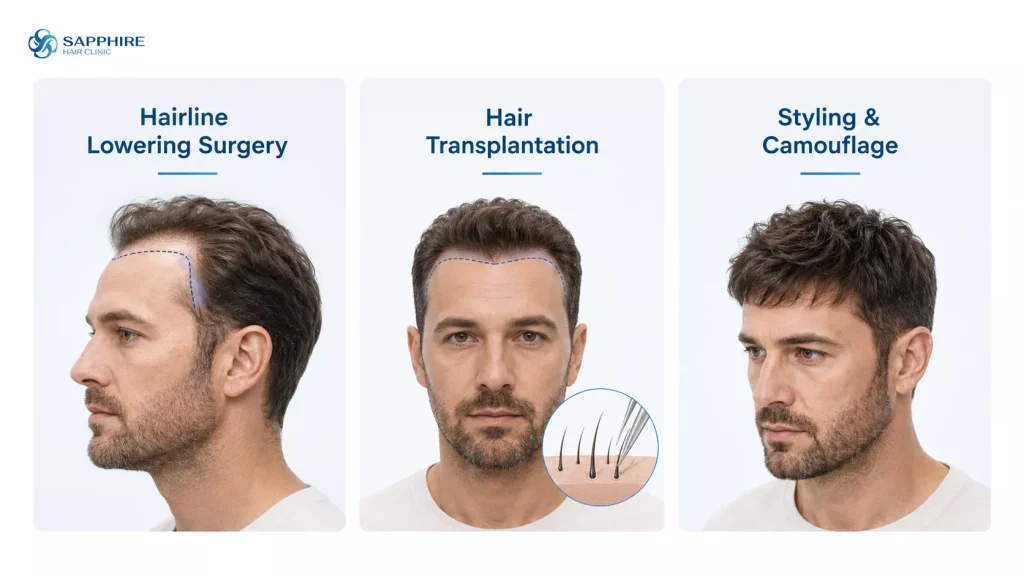
- Hairline lowering surgery moves the existing hair-bearing scalp forward to reduce visible forehead height.
- Hair transplantation places individual follicles into the frontal area to create a lower or more defined hairline.
- Hairstyle modification uses fringes, layers, curls, or strategic volume to visually shorten the forehead.
- Cosmetic contouring uses makeup techniques to reduce the visual prominence of the upper forehead.
- Combination treatments may be considered when hairline position and density both need to be addressed.
Forehead Reduction: How Does Hairline Lowering Surgery Work?
Hairline lowering surgery, sometimes called forehead reduction surgery, involves surgically advancing the hair-bearing scalp toward the forehead. A carefully planned incision is usually made along the existing frontal hairline, and a section of forehead skin is removed before the scalp is repositioned. The exact amount of advancement depends on scalp flexibility, hairline characteristics, skin quality, and the surgeon’s assessment.
This type of forehead reduction can create an immediate change in forehead height, which makes it different from hair transplantation where visible growth develops gradually. However, it also involves an incision and therefore requires careful discussion of healing, scarring, hairline design, and long-term stability. It may not be suitable for people with an unstable or progressively receding hairline.
| Factor | Why It Matters for Hairline Lowering |
|---|---|
| Scalp flexibility | Influences how far the scalp can safely advance |
| Existing hair density | Helps determine how well the new hairline can frame the face |
| Hairline stability | Progressive recession may affect long-term appearance |
| Scar tendency | Influences incision planning and expectations |
| Facial proportions | Helps determine a natural target hairline |
Forehead Reduction: Can a Hair Transplant Make the Forehead Look Smaller?
Hair transplantation is another important forehead reduction option because it can create a new hairline without physically advancing the scalp. Follicles are generally taken from a stable donor region and transplanted into carefully designed areas along the forehead and temples. By creating hair growth below the original hairline, the visible height of the forehead can be reduced.
A major advantage of this approach is the ability to customize shape and density. Hair transplantation can be particularly useful when the temples also require restoration or when a softer, irregular hairline is desired. Unlike surgical advancement, however, the visual change is not immediate. Transplanted hairs need to go through their natural growth cycle before the final forehead reduction effect becomes clear.
Forehead Reduction: Hair Transplant or Hairline Lowering Surgery?
Choosing between hair transplantation and surgical hairline lowering depends on anatomy and expectations rather than simply choosing the procedure that sounds more convenient. Hairline lowering can produce an immediate positional change, whereas transplantation offers greater flexibility in shaping the hairline and adding density to specific areas.
| Comparison | Hair Transplant | Hairline Lowering Surgery |
|---|---|---|
| Hairline change | Created with new follicle growth | Existing hairline is moved forward |
| Result timing | Develops gradually | Position changes immediately |
| Donor hair required | Yes | Usually not for the main procedure |
| Incision along hairline | No long linear advancement incision | Usually required |
| Shape customization | Highly flexible | Depends on existing hairline |
| Suitable for temple work | Often useful | May require an additional approach |
Forehead Reduction: Who May Be a Good Candidate?
A person considering forehead reduction should have realistic expectations about what can be achieved while maintaining natural facial proportions. For hair transplantation, sufficient donor density is important. For surgical hairline lowering, scalp flexibility and a stable frontal hairline are significant considerations. General health and the ability to heal properly also matter for surgical approaches.
Age should be considered together with future hair-loss risk. A very low hairline may look attractive in the short term but become difficult to maintain if surrounding native hair begins to recede later. A conservative forehead reduction design usually aims for a result that still looks appropriate as the face and hairline change over time.

Forehead Reduction: What Should Be Considered Before Choosing a Procedure?
Before deciding on a permanent forehead reduction treatment, several points should be evaluated carefully. The objective should be a balanced forehead rather than simply achieving the lowest possible hairline.
- The cause of the high or large-looking forehead should be identified.
- Existing and potential future hair loss should be considered.
- Donor hair quality should be assessed if transplantation is planned.
- Scalp flexibility should be examined when considering surgical advancement.
- The hairline should be designed according to facial proportions rather than a fixed measurement.
- Temple shape and frontal density should be included in the plan.
- Possible scarring and recovery requirements should be discussed.
- Expectations should be based on individual anatomy rather than another person’s result.
Forehead Reduction: Why Hairline Design Matters
Hairline design is one of the most important elements of any permanent forehead reduction procedure. A perfectly straight or excessively low line may make the forehead smaller but can also create an unnatural appearance. Natural hairlines contain subtle irregularities, variations in density, and gradual transitions around the temples.
The design should also reflect age and gender-related facial characteristics without relying on rigid templates. A successful forehead reduction should look as though the new hairline has always belonged to the face. This is why pre-procedure planning often deserves as much attention as the technical part of the procedure itself.
Forehead Reduction: Can Hairstyles Make a Difference Without Surgery?
Hairstyles can change perceived forehead proportions considerably, making them useful for people who are not ready for permanent forehead reduction. Bangs, curtain fringes, textured layers, side parts, curls, and strategic volume around the temples can visually shorten the distance between the eyebrows and hairline.
This approach does not physically alter the forehead or hairline, but it can help someone understand which proportions they prefer before considering a permanent treatment. People with thin frontal hair may need to avoid styles that place excessive tension on the hairline, particularly if traction is already contributing to thinning.
Forehead Reduction: Can Makeup and Contouring Help?
Cosmetic contouring can create a temporary forehead reduction effect by applying slightly darker tones around the upper forehead and hairline. When blended properly, this can make the forehead appear shorter and shift visual attention toward the center of the face. Hairline powders may also help disguise small areas of thinning or irregularity.
These methods are temporary and do not change the actual position of the hairline. Their main advantage is flexibility: the effect can be adjusted or removed easily. They can be useful for people who want to experiment with facial proportions before deciding whether a medical or surgical forehead reduction treatment is appropriate.
Forehead Reduction: How Long Do Results Last?
The longevity of forehead reduction results depends on the method used. Hairstyling and makeup effects last only until the next wash or change in styling. Surgical hairline lowering creates a structural change, although future natural hair loss may alter the appearance surrounding the repositioned hairline.
Hair transplantation is intended to provide long-lasting growth when stable donor follicles are used, but native hair can still change over time. This is why a long-term forehead reduction plan should consider future thinning rather than focusing exclusively on the immediate appearance after treatment.
Forehead Reduction: What Does Recovery Involve?
Recovery differs substantially between procedures. After hair transplantation, small crusts, redness, mild swelling, and temporary shedding may occur before new hair growth begins. After surgical hairline lowering, patients may experience swelling, tightness, temporary numbness, and healing along the incision line. Specific recovery instructions vary according to the procedure and the individual.
Following postoperative guidance is particularly important because the early healing period can influence both comfort and the final appearance. Hair washing, physical activity, sun exposure, and hair styling may need to be modified temporarily. Anyone considering forehead reduction should understand not only the potential result but also the recovery requirements of the chosen treatment.
Forehead Reduction: How Much Can the Forehead Be Reduced?
There is no universal measurement that applies to every forehead reduction patient. In hairline lowering surgery, the possible advancement depends heavily on scalp mobility and anatomy. With hair transplantation, the amount of apparent reduction depends on available donor hair, hair thickness, recipient area size, and the shape of the proposed hairline.
Trying to reduce the forehead excessively can compromise natural proportions or make it difficult to create convincing density. The most successful approach usually prioritizes balance. A slightly more conservative hairline with natural density often looks better than an aggressively lowered line that does not harmonize with the rest of the face.
Frequently Asked Questions
Forehead Reduction: Is Hair Transplantation Permanent?
Transplanted follicles taken from stable donor areas are generally selected because they are more resistant to the processes responsible for common pattern hair loss. Once established, these follicles can provide long-term growth. However, the surrounding native hair may continue to thin, which means future appearance still needs to be considered during forehead reduction planning.
For this reason, a hair transplant should not be viewed as simply filling every available space at one moment in time. Preserving donor resources and designing a hairline that can remain balanced despite future changes are important parts of long-term planning.
Forehead Reduction: Does the Procedure Leave Scars?
Any surgical procedure that involves an incision can potentially leave a scar. Surgical hairline lowering generally creates an incision along the frontal hairline, and the eventual visibility of the scar varies according to surgical technique, individual healing, hair density, and scar characteristics.
Hair transplantation uses many small extraction and implantation points rather than the same type of advancement incision. These can also leave tiny marks, although their visibility varies. Scar expectations should be discussed before choosing a forehead reduction procedure.
Forehead Reduction: Can Women Have a Forehead Reduction Procedure?
Women can consider several forehead reduction approaches when they have a naturally high hairline or suitable patterns of frontal thinning. Both hair transplantation and surgical hairline lowering may be considered depending on scalp characteristics, donor density, hairline stability, and personal goals.
Diffuse female hair loss requires particularly careful assessment because transplantation may not be appropriate when the donor area is also affected. Identifying the cause of thinning before selecting a permanent procedure is therefore important.
Forehead Reduction: Which Option Looks the Most Natural?
Naturalness depends more on planning and execution than on the name of the procedure. Hair transplantation can provide highly customized density and shape, while surgical hairline lowering can create a significant positional change using the patient’s existing frontal hair.
The best forehead reduction option is the one that suits the person’s anatomy, hair characteristics, age, and long-term hair-loss pattern. A technically successful procedure should reduce the prominence of the forehead without drawing attention to the fact that the hairline has been altered.
Forehead Reduction: How Do I Choose the Right Option?
The decision should begin with determining why the forehead appears large. If the main issue is a naturally high but dense and stable hairline, surgical advancement may be worth discussing. If the goal is to reshape the temples or create additional frontal density, hair transplantation may offer greater flexibility.
A personalized evaluation is important because the same forehead reduction treatment can produce very different results on different faces. Scalp structure, donor availability, existing hair density, future hair-loss risk, and preferred hairline shape should all be considered before making a decision.