

If you have been researching hair transplant options, you have probably come across the term DHI. Direct Hair Implantation, commonly known as DHI, is one of the most advanced hair restoration techniques available today. It has become particularly popular in Turkey, where thousands of international patients travel each year to undergo the procedure at world-class clinics. But what exactly is DHI, how does the Choi pen work, and why is Turkey considered one of the best destinations for this treatment? This guide covers everything you need to know.
What Is DHI Hair Transplant?
DHI hair transplant is an advanced variation of the Follicular Unit Extraction (FUE) technique. While both methods involve extracting individual hair follicles from a donor area, DHI takes the process a step further by eliminating one of the traditional steps entirely. In a standard FUE procedure, the surgeon must first create incisions or channels in the recipient area before implanting the harvested follicles. With DHI, both steps happen simultaneously using a single specialised tool known as the Choi implanter pen.
This means no pre-made incisions, no open channels, and significantly less trauma to the scalp. The result is a more precise, controlled procedure that typically produces denser, more natural-looking hair growth with a faster recovery time.
How Does the Choi Pen Work?
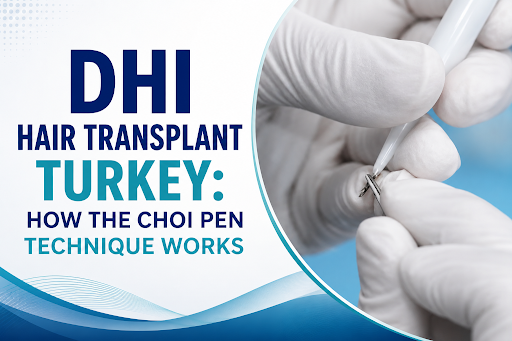
The Choi implanter pen is the defining tool of the DHI technique and the key reason it produces such precise results. It resembles a medical pen with a hollow, ultra-fine needle at one end. The surgeon loads a harvested hair follicle directly into the tip of the pen. When the pen is pressed against the scalp, it simultaneously creates a tiny opening and implants the follicle in a single motion.
This dual-action mechanism is what sets DHI apart. Because the follicle is implanted immediately after being loaded into the pen, it spends minimal time outside the body. This greatly improves graft survival rates compared to techniques where follicles must wait in a preservation solution while channels are manually created one by one.
The Choi pen also gives the surgeon complete control over three critical factors: the angle, depth, and direction of each implanted follicle. This level of precision means hair can be positioned to match the natural growth pattern of the patient’s existing hair, producing results that are virtually indistinguishable from natural growth. Most surgeons use several Choi pens during a single session, rotating between them to maintain efficiency and ensure each pen is always loaded with a fresh follicle ready for implantation.
The DHI Hair Transplant Procedure: Step by Step
Understanding the process from start to finish helps patients know exactly what to expect on the day of their procedure.
The session begins with the administration of local anaesthesia to numb both the donor and recipient areas. This takes effect within a few minutes and ensures the patient remains comfortable throughout the procedure. Once the scalp is fully numbed, the surgeon uses a micro punch tool to extract individual hair follicles from the donor area, which is typically located at the back of the head where hair is genetically resistant to balding.
The harvested follicles are then loaded one by one into the Choi implanter pens. The surgical team works efficiently to keep the follicles outside the body for as short a time as possible. From this point, the surgeon begins implanting each follicle directly into the thinning or balding areas of the scalp. The pen creates a tiny, precise entry point and deposits the follicle in the same action, with the angle and direction carefully controlled to achieve a natural hairline and uniform density.
A full DHI session typically takes between six and eight hours depending on the number of grafts being transplanted. Because it is an outpatient procedure, patients can return to their accommodation the same day without needing to stay overnight at the clinic.
How Many Grafts Can Be Transplanted with DHI?
One important consideration with DHI is that it has a practical limit in terms of graft count per session. Due to the highly meticulous nature of the technique, transplanting between 3,000 and 3,500 grafts in a single session is generally considered the maximum. For patients requiring more extensive coverage, the surgeon may recommend scheduling a second session or discussing whether a combined approach using both DHI and FUE might be more appropriate.
This is why DHI is particularly well suited to patients who need to fill smaller or more targeted areas, enhance hairline density, or address moderate hair loss rather than very advanced or extensive balding.
DHI vs FUE: What Is the Difference?
Both DHI and FUE are minimally invasive techniques that extract individual follicles from a donor area, but there are meaningful differences between them that affect which technique a surgeon might recommend.
With traditional FUE, the surgeon opens all the channels in the recipient area before implanting follicles. This means follicles must wait in storage while the channels are created, which can slightly reduce graft survival if the waiting time is prolonged. DHI eliminates this waiting period entirely by loading and implanting each follicle directly, one at a time.
DHI also avoids the need to shave the recipient area in some cases, making it a preferred choice for patients who want to keep their existing hair length intact during recovery. FUE, by comparison, often requires both the donor and recipient areas to be fully shaved before surgery.
In terms of cost, DHI is generally more expensive than FUE due to the specialised equipment required, the higher level of surgical expertise involved, and the longer procedure time. However, for patients who prioritise precision and density in targeted areas, the additional cost is often considered worthwhile.
Is DHI Hair Transplant Painful?
DHI is not a painful procedure. Because the scalp is fully anaesthetised with local anaesthesia before the procedure begins, patients feel little to no pain during the surgery. Some mild pressure or a slight sensation during anaesthetic injections is normal, but the actual extraction and implantation steps are virtually painless.
After the procedure, patients may experience mild soreness, tenderness, or itching in the treated areas for a few days. These are entirely normal and typically resolve quickly. Pain relief medication is usually provided as part of the aftercare package to keep patients comfortable during the initial recovery period.
Recovery After DHI Hair Transplant
One of the major advantages of DHI is its relatively straightforward recovery process. Because the technique does not involve large incisions or stitches, the scalp heals quickly. Mild swelling and redness around the transplant area are common in the first few days but usually subside within a week.
Patients are advised to avoid strenuous physical activity, direct sun exposure, and touching or scratching the treated area during the first couple of weeks. Gentle washing with a recommended shampoo can typically begin within a few days of the procedure, following the specific guidance provided by the clinic.
Temporary shedding of the transplanted hair, often called shock loss, is a completely normal part of the recovery cycle. This usually occurs within the first few weeks and is not a cause for concern. New hair growth typically begins to appear around three to four months after the procedure, with significant density and coverage developing between six and twelve months. Full results are usually visible by the end of the first year.
Why Choose Turkey for DHI Hair Transplant?
Turkey has established itself as one of the leading destinations in the world for hair transplant procedures, and DHI in particular attracts a large number of international patients to Istanbul and other major cities every year. There are several strong reasons why patients choose Turkey over their home countries for this treatment.
The cost difference is the most immediate factor. A DHI hair transplant in Turkey typically costs between $2,000 and $5,500 for an all-inclusive package, compared to $10,000 or more in the United Kingdom, and significantly higher in the United States. These packages often include airport transfers, hotel accommodation, post-operative care kits, and follow-up consultations, making Turkey a highly cost-effective option without compromising on quality.
Beyond affordability, Turkey is home to a large number of highly experienced hair transplant surgeons who perform thousands of procedures each year. This volume of practice means Turkish specialists have refined their techniques to a high degree, and many clinics use the latest generation of Choi implanter pens and supporting technology to deliver consistently excellent results.
The country also benefits from strong regulatory standards set by the Turkish Ministry of Health, and many leading clinics hold international accreditations that confirm their adherence to global medical best practices.
Conclusion
DHI hair transplant is one of the most precise and effective methods of hair restoration available today. The Choi pen technique gives surgeons unparalleled control over every implanted follicle, producing natural-looking results with excellent graft survival rates and a faster recovery compared to older methods. For patients considering hair restoration, Turkey offers an exceptional combination of surgical expertise, advanced technology, and affordable all-inclusive packages that make it one of the smartest choices in the world. At Sapphire Hair Clinic, our experienced team offers personalised DHI hair transplant solutions tailored to your individual hair loss pattern, hairline goals, and long-term results. Contact us today for a free consultation and take the first step towards restoring your confidence.